
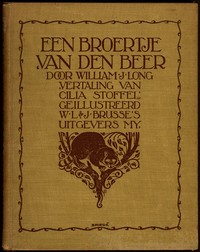
Een Broertje van den Beer by William J. Long
Published in the early 1900s, William J. Long's book is a gentle, novel-length biography of a black bear cub. Long was a naturalist who believed animals had individual personalities and intelligence, and he writes this story with deep affection and close observation.
The Story
The book follows the cub from his birth in a snug winter den. We see the world through his eyes as he learns everything for the first time: the taste of his mother's milk, the strange scent of the air outside, the texture of moss and bark. His mother is his fierce protector and teacher, showing him how to find grubs under logs, catch fish in a stream, and climb trees to safety. The forest is full of other characters—a grumpy old moose, playful otters, and the ever-watchful fox. The cub's year is one of constant discovery, punctuated by moments of pure instinct, like his first terrifying encounter with a human scent or the thrilling chase after a honeybee. The story moves with the seasons, from the lush abundance of summer to the lean hunger of autumn, as the cub grows stronger and more capable.
Why You Should Read It
This isn't a thriller, but it has a quiet magic that pulls you in. Long makes you care deeply about this little bear. You cheer for his small victories and feel a pang when he gets a scare. The writing turns simple acts—turning over a rock or sniffing the wind—into little adventures. It slows you down. In a world of constant noise, reading this feels like a deep breath of pine-scented air. It also challenges the idea of animals as just mindless creatures. Here, the bear thinks, remembers, feels curiosity, and even shows a sense of humor. It's a respectful and heartfelt portrait that makes the wild feel familiar.
Final Verdict
Perfect for anyone who loves animal stories, from fans of 'Watership Down' to readers of modern wildlife memoirs. It's also ideal if you're feeling burnt out and need a peaceful, absorbing read that connects you to nature. Because it was written over a century ago, the pace is deliberate and the style is descriptive—so it's best for readers who don't mind a slower, more reflective journey. If you pick it up, be prepared to look at the next squirrel in your yard with a little more curiosity.
This digital edition is based on a public domain text. Feel free to use it for personal or commercial purposes.
Matthew Wilson
1 year agoLooking at the bibliography alone, the practical checklists included are a great touch for real-world use. Highly recommended for those seeking credible information.
David Smith
10 months agoGiven the current trends in this field, the way it challenges the status quo is both daring and well-supported. Truly a masterpiece of digital educational material.
Elizabeth Wilson
1 year agoFinally found a version that is easy on the eyes.
Nancy Martin
2 years agoHaving read the author's previous works, the critical analysis of current industry standards is very timely. A rare gem in a sea of mediocre content.


Linda Rodriguez
1 year agoA brilliant read that I finished in one sitting.