
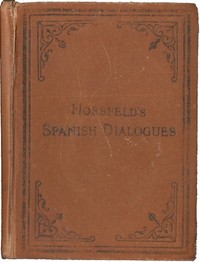
Hossfeld's Spanish Dialogues, and Idiomatic Phrases Indispensible for a Rapid…
Let's be clear: this isn't a novel. There's no sweeping plot or cast of characters. Instead, Hossfeld's Spanish Dialogues presents a series of practical scenes from early 20th-century life. Think of it as a script for living abroad a century ago.
The Story
The 'story' unfolds through conversations you might actually need to have. One chapter walks you through checking into a hotel, from asking for a room to complaining about the noise. Another guides you through hiring a carriage, discussing the price and destination. There are dialogues for the tailor's shop, the post office, and even for dealing with a doctor. Each scene is a mini-drama of daily negotiation and interaction. You're not just learning words; you're learning the rhythm of conversation, the expected questions and replies. It's a survival guide for a world without apps or phrasebooks, where your ability to chat directly impacted your journey.
Why You Should Read It
I love this book for two big reasons. First, it's incredibly practical. The phrases are direct and functional. Second, and more fascinatingly, it's a window into another time. The social customs are front and center. You learn how to formally address people, the etiquette of tipping, and what a traveler was expected to know. It shows what mattered to people in 1910. Reading a dialogue about hiring a servant or sending a telegram is a history lesson in itself. The language is clean and simple, focused purely on getting the point across. It has a no-nonsense charm that modern textbooks often lack.
Final Verdict
This book is perfect for a very specific reader: the language nerd who also loves social history. If you're looking for a modern, comprehensive Spanish course, look elsewhere. But if you're curious about how people actually communicated in the past, or if you want to add some charming, old-fashioned phrases to your Spanish, this is a gem. It's for the traveler who enjoys the journey as much as the destination, and for anyone who believes that learning a language is about connecting with people, both past and present. Keep it on your shelf next to your modern grammar book—it's the fascinating, quirky companion.
You are viewing a work that belongs to the global public domain. Thank you for supporting open literature.
Ethan Gonzalez
1 year agoThis is one of those stories where the arguments are well-supported by credible references. A valuable addition to my collection.









Richard Thompson
3 months agoI have to admit, the storytelling feels authentic and emotionally grounded. One of the best books I've read this year.