
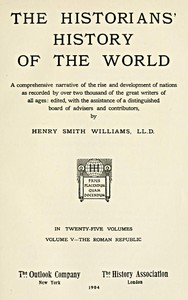
The historians' history of the world in twenty-five volumes, volume 05 : the…
Let's be clear: this is not a novel. 'The Historians' History of the World' is a monumental early-20th-century effort to compile global history, and Volume 5 focuses on a specific, turbulent chunk of the past.
The Story
This volume zeroes in on the last 100 years of the Roman Republic, roughly from 133 BC to 27 BC. It charts the Republic's death spiral. The story starts with internal reformers, the Gracchi brothers, who try to fix massive wealth inequality and get murdered by the Senate for their trouble. This breaks a sacred norm—political violence becomes a tool. From there, it's a downward slide. Powerful generals like Marius and Sulla realize their loyal troops matter more than Senate decrees. They march on Rome itself, purging their enemies. The old balance of power is gone. The book follows this chaos through the rise of figures like Pompey, Crassus, and finally Julius Caesar, who crosses the Rubicon and shatters the Republic for good. It ends at the dawn of the Empire under Augustus, showing not just what happened, but the decades of rot that made it inevitable.
Why You Should Read It
What's compelling here is the sheer, cumulative weight of the breakdown. You see each crisis—a land reform, a military command, a debt crisis—not as an isolated event, but as another hammer blow to the system. The anonymous editors pull from older 19th-century sources, giving you a fascinating look at how history was understood a century ago. Their focus is on institutions and processes. While you won't get deep psychological profiles of Caesar, you get a crystal-clear autopsy of the political body that failed to contain him. It's a masterclass in how republics die: not always with a single bang, but with a long series of cracks, norms being ignored, and good people deciding the ends justify terrible means.
Final Verdict
This is a specialist's book, but with wide appeal if you're in the right headspace. It's perfect for history buffs who already know the basic 'who's who' of late Republican Rome and want to understand the 'how' and 'why' of its collapse in intense, old-school detail. It's also great for anyone interested in political science and the fragility of systems. It is not a light, narrative introduction. The prose is dense and the perspective is dated. But as a primary source on how early-20th-century scholars saw Rome's fall, and as a remarkably thorough chronicle of institutional failure, it's absolutely absorbing. Think of it as the deep-cut, vinyl record version of Roman history.
This historical work is free of copyright protections. Preserving history for future generations.
Liam Williams
4 months agoFrom the very first page, the plot twists are genuinely surprising. I will read more from this author.
Margaret Sanchez
1 year agoI didn't expect much, but the narrative structure is incredibly compelling. Exactly what I needed.
Amanda Harris
10 months agoI started reading out of curiosity and the arguments are well-supported by credible references. Truly inspiring.
Daniel Thompson
6 months agoEssential reading for students of this field.









Emily Anderson
1 year agoFrom the very first page, it provides a comprehensive overview perfect for everyone. I couldn't put it down.